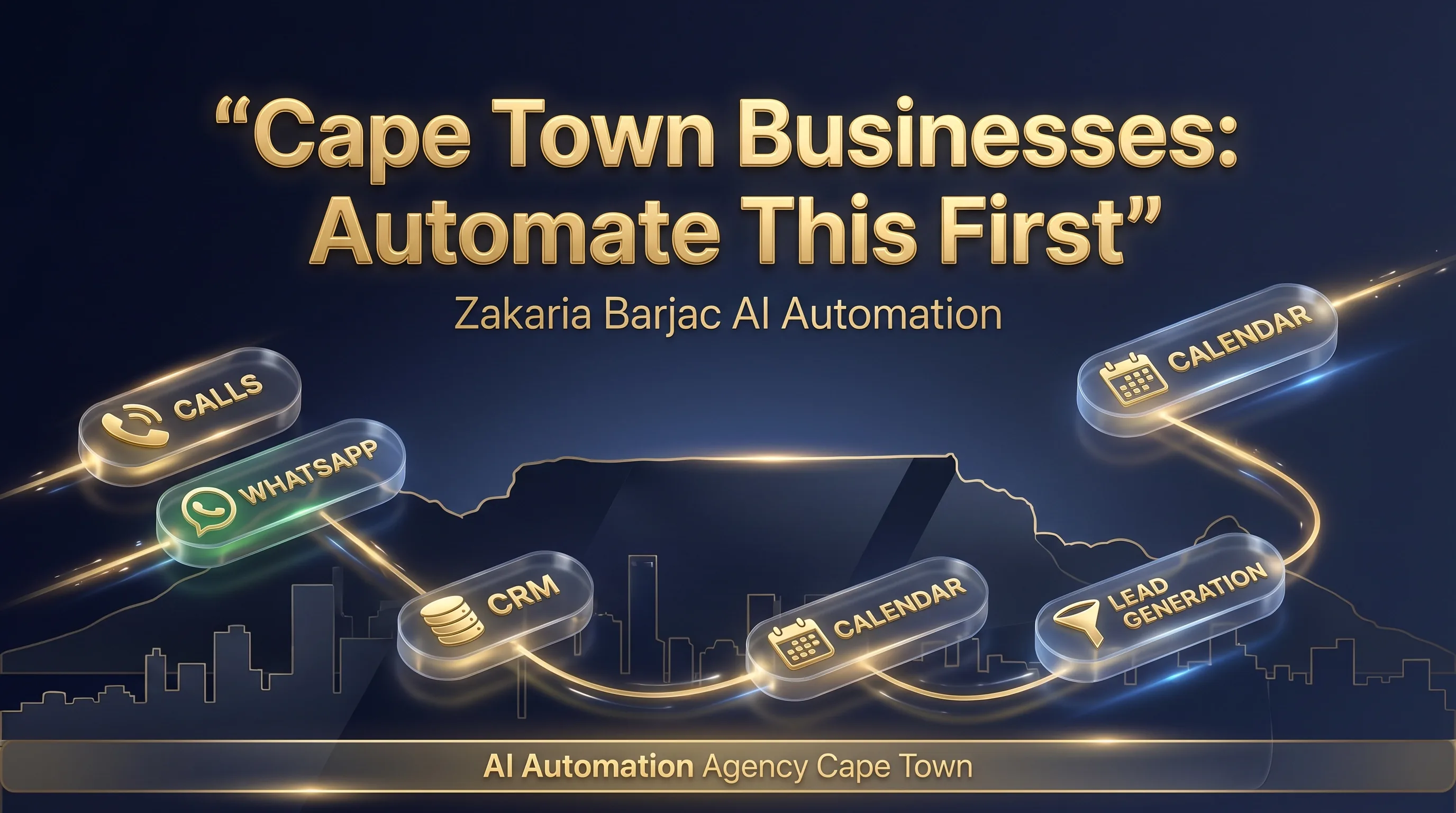
Cape Town businesses can start with call handling, WhatsApp follow-up, CRM updates, and appointment automation.
Cape Town SMEs in 2026 face a recognisable mix of pressures: rising labour costs, after-hours customer expectations, loadshedding-shaped workdays, and the constant question of where time is actually leaking. AI automation can help with all of these, but only if you start in the right place. This is a practical priority guide for Cape Town business owners deciding what to automate first.
Why this question matters
Three structural reasons Cape Town SMEs are unusually well-positioned to benefit from automation:
- Skills shortage and labour costs. Hiring administrative staff is harder and more expensive than it was a few years ago. Automation reduces dependency on hard-to-fill roles without making redundancies.
- After-hours coverage gaps. Most Cape Town SMEs operate within standard business hours, but customer demand often peaks outside that window — toothache calls at 8pm, property enquiries on a Sunday morning. AI fills the gap without overtime cost.
- Loadshedding-shaped operations. Cloud-hosted automation isn't affected by stage 6, but your office probably is. Designing for failover (LTE backup, mobile alerts) is something Cape Town businesses have to think about that businesses in other markets don't.
The five automation areas to consider first
For most Cape Town SMEs, these are the highest-leverage starting points — directional priority order, but the right one for your business depends on where your specific bottleneck sits:
| Automation area | Why it matters in CT | Reasonable first step |
|---|---|---|
| Missed-call recovery | Voicemail callback rates are commonly low; missed calls are silent revenue leakage | Auto-message any caller who didn't connect, inviting them to book or message back |
| WhatsApp lead response | Messaging is increasingly the first-touch channel for SA buyers | Instant first reply with personalised acknowledgement and qualification |
| Appointment booking | Booking gap is one of the most common revenue leaks in service businesses | Universal capture flow that books straight into the calendar |
| CRM sync | Manual data entry burns receptionist or admin time | AI captures lead details once and writes them into your CRM |
| Follow-up sequences | Most leads die quietly without consistent follow-up | Automated nurture for cold leads with clear opt-out |
By industry — where the highest-leverage starting point tends to sit
Illustrative starting points by sector — these are general patterns, not promises:
- Healthcare: after-hours call answering and missed-call recovery. See AI receptionist for dental clinics and AI receptionist for doctors.
- Real estate: instant first reply on WhatsApp portal leads. See WhatsApp automation for real estate agents.
- Professional services: lead qualification + automated booking. See AI lead qualification and automated appointment booking.
- Hospitality and trades: missed-call text-back is often the single biggest win. See AI missed call text back.
Loadshedding-aware design
Two practical things to think about before going live in Cape Town:
- Failover for your local internet. Cloud AI services don't go down in stage 6, but your office fibre might. An LTE backup router and a small UPS are usually enough to keep inbound channels working.
- Failover for telephony. If your phone forwarding depends on office equipment, build a path that works when the equipment is offline. Number portability through a cloud telephony provider tends to handle this cleanly.
Privacy and regulatory considerations
AI systems that handle personal information should be designed with privacy and regulatory requirements in mind, including the Protection of Personal Information Act (POPIA) and any sector-specific guidance. Specific compliance depends on configuration and should be reviewed with your own legal or compliance adviser before going live. Vendors that promise blanket compliance are overstating what a vendor can promise.
Common mistakes to avoid
- Going broad before deep. One area automated well beats five areas automated poorly. Pick the bottleneck, build it, prove it, then expand.
- Over-automating customer relationships. The fastest reply isn't always the best one. Some interactions need a human; design escalation paths for those.
- Choosing tools without integration discipline. A best-in-class tool that doesn't talk to your CRM creates more work, not less.
- Skipping the soft-launch. Run the AI alongside humans for the first week or two and review transcripts before going fully live.
- Buying based on a brochure, not a 30-day audit. The cheapest insurance is benchmarking your current call volume, missed-call rate, and reply times before committing scope.
How to choose an automation partner
Practical signals that tend to separate solid partners from sales-driven ones:
- Local context. Loadshedding-aware design, POPIA awareness, an understanding that messaging is more important than email for many SA customers.
- Honest framing. A partner who tells you when their product wouldn't pay for itself for your specific business is more trustworthy than one who promises percentage savings without seeing your data.
- Soft-launch discipline. Any deployment should run in shadow mode before going fully live. If a vendor wants to skip that, walk away.
- Reasonable contract terms. Confidence in the service tends to come with month-to-month or short-term commercial terms, not multi-year lock-ins.
When this is a good fit
- SME with consistent monthly turnover and digital-first customer interaction
- Identified bottleneck in admin, lead response, missed calls, or after-hours coverage
- Willingness to commit to a soft-launch period before going fully live
When this is not a good fit
- Pure cash-and-carry retail with no digital touchpoint
- Businesses where the owner handles everything personally and is not at capacity
- Operations without a digital CRM or scheduling system that can be integrated
How Zakaria Barjac AI Automation can help
We build AI automation systems for Cape Town SMEs and other South African businesses. A typical engagement starts with a discovery call to map operational bottlenecks, then a focused first build covering the highest-leverage area (often missed-call recovery or WhatsApp lead response), then incremental expansion as the foundation proves itself.
For broader regional context, see our guide on AI automation for South African SMEs. For specific operational deep-dives, see AI receptionist vs human receptionist, automated appointment booking, and AI missed call text back.
You can also call our AI demo line to hear an example voice agent in action: +1 (831) 387-7821.
Book a free strategy call → — we'll review your operational bottlenecks and discuss what's realistically possible to automate first.