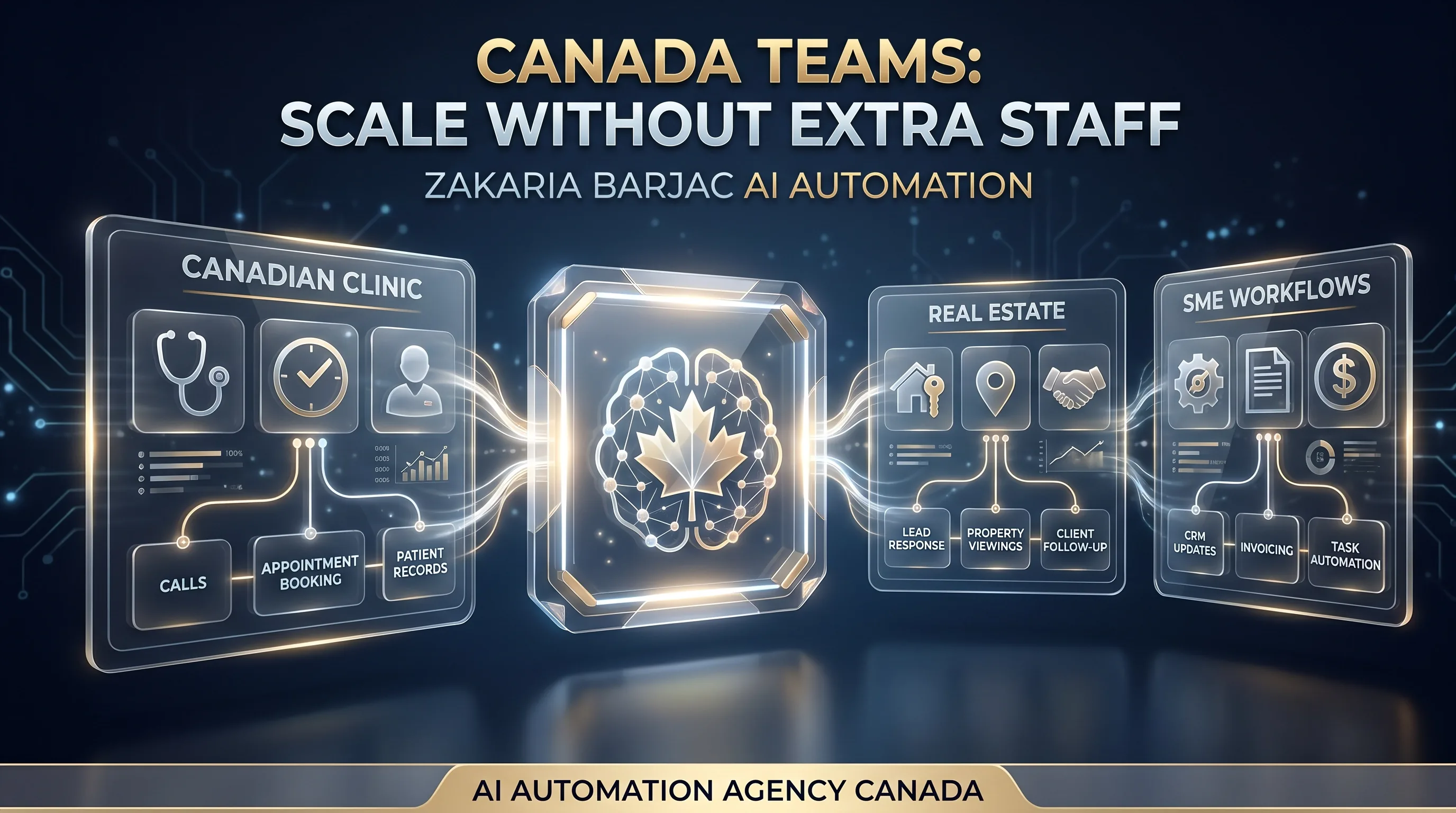
Canadian clinics, realtors, and SMEs can use AI automation to scale service without adding extra staff.
Canadian SMEs face high labour costs, tight margins, and a tight labour market. AI automation is a leverage play in this environment — not a replacement for your team, but a way to absorb the predictable, repetitive parts of your operations so the people you have can focus on what genuinely needs them. This article is a practical priority guide for Canadian business owners considering where to start.
Why this question matters
Three structural reasons AI automation tends to fit Canadian SMEs unusually well:
- Labour cost pressure. Provincial minimum wages, payroll taxes, benefits, CPP, EI, and vacation pay add up. Reducing dependence on hard-to-fill admin roles becomes more valuable each year.
- Time-zone spread. Canada spans multiple time zones. A clinic with patients across Ontario and BC has natural after-hours gaps that customers don't see as your problem — they just call the next provider.
- Bilingual coverage in some markets. Quebec and parts of New Brunswick require thinking about French as a service expectation, not an afterthought.
The five automation areas to consider first
| Automation area | Why it matters in Canada | Reasonable first step |
|---|---|---|
| Missed-call recovery | Voicemail callback rates are commonly low; missed calls leak to competitors silently | Auto-message any caller who didn't connect, inviting them to book or message back |
| Lead response automation | Speed of first reply is a strong predictor of conversion in many service categories | AI replies within roughly a minute, asks qualifying questions, offers a slot |
| Appointment booking | Booking gap is a common revenue leak in service businesses | Universal capture flow that books straight into the calendar |
| After-hours coverage | Time-zone spread + standard work hours leave a real coverage gap | AI handles after-hours triage and books for the next available slot |
| Routine admin | Repeat scripts, sick notes, status queries consume disproportionate staff time | AI handles capture; humans approve in batch |
By industry — where the highest-leverage starting point tends to sit
Illustrative starting points by sector — these are general patterns, not promises:
- Medical and dental clinics: overflow + after-hours call answering, plus reminders to reduce no-shows. See AI receptionist for doctors and AI receptionist for dental clinics.
- Real estate brokerages: instant first reply on portal-sourced messaging leads. See messaging automation for real estate agents.
- Professional services: lead qualification + automated booking. See AI lead qualification and automated appointment booking.
- Trades and home services: missed-call text-back is often the single biggest win. See AI missed call text back.
Privacy and regulatory considerations for Canada
AI deployments in Canada that handle personal information should be designed with applicable privacy laws in mind, including the federal Personal Information Protection and Electronic Documents Act (PIPEDA), provincial laws such as Quebec's modernised privacy regime (commonly referred to as Law 25), and equivalent regimes in BC and Alberta. Sector-specific guidance (health regulators, real estate councils, financial services) may also apply. Specific compliance depends on configuration and should be reviewed with a Canadian legal or compliance adviser before going live. We don't make blanket compliance guarantees — anyone who does is overstating what a vendor can promise.
Bilingual coverage
For businesses serving Quebec, bilingual French/English handling is a service-level expectation, not optional. Language coverage depends on the underlying voice and text models and the project scope. We discuss specific language needs during scoping rather than make blanket coverage claims.
How a remote engagement actually works
Cloud-based AI doesn't require physical proximity to your office. A typical engagement looks like this:
- Discovery call. Map operational bottlenecks against your call volume, lead flow, and current admin patterns. Identify the highest-leverage starting point.
- Scoping. Agree the specific scope, integration points, and timeline. Honest scoping over rosy projections.
- Build and configuration. Voice/messaging agent set up, integrations built where APIs allow, scripts tuned to your business.
- Soft launch (shadow mode). AI runs alongside human staff initially. Transcripts reviewed before going fully live.
- Go-live and ongoing optimisation. Performance monitoring, weekly transcript review during the early period, refinement as patterns emerge.
Specific timelines depend on scope and integration complexity. We give an honest estimate during scoping rather than committing to a rosy figure upfront.
Common mistakes to avoid
- Under-scoping privacy law. A Quebec-facing deployment that ignores Law 25, or a healthcare deployment that ignores provincial health-data rules, creates legal exposure that no automation upside can offset.
- Ignoring bilingual SLA expectations in Quebec. If your service operates in Quebec, French handling needs to be a first-class concern.
- Telephony number portability gotchas. Moving to cloud telephony can create unexpected friction with provincial regulators or existing carrier contracts. Plan ahead.
- Treating it as set-and-forget. Review transcripts during the early weeks to catch tone, edge cases, and embarrassing failures before they multiply.
- Buying based on a brochure, not an audit. Benchmark current call volume, missed-call rate, and reply times before committing scope.
When this is a good fit
- SMEs with consistent inbound enquiry volume and digital-first customer interaction
- Clear bottleneck in admin, lead response, missed calls, or after-hours coverage
- Willingness to commit to a soft-launch period before going fully live
When this is not a good fit
- Businesses where the owner handles everything personally and is not at capacity
- Pure walk-in retail with no digital touchpoint
- Operations without a digital CRM or scheduling system that can be integrated
Cost framing
Costs vary by scope, integration depth, and language requirements. The honest framing: AI automation tends to pay back when there's clear evidence of leakage — missed calls, slow replies, dropped leads, manual work that could be redirected. Specific pricing depends on scope and is discussed during scoping.
How Zakaria Barjac AI Automation can help
We build AI automation systems for Canadian SMEs. A typical engagement starts with a discovery call to map operational bottlenecks, then a focused first build covering the highest-leverage area (often missed-call recovery, after-hours call answering, or lead response), then incremental expansion as the foundation proves itself.
For specific operational deep-dives, see AI receptionist vs human receptionist, automated appointment booking, and AI missed call text back.
You can also call our AI demo line to hear an example voice agent in action: +1 (831) 387-7821.
Book a free strategy call → — we'll review your operational bottlenecks and discuss what's realistically possible to automate first.